

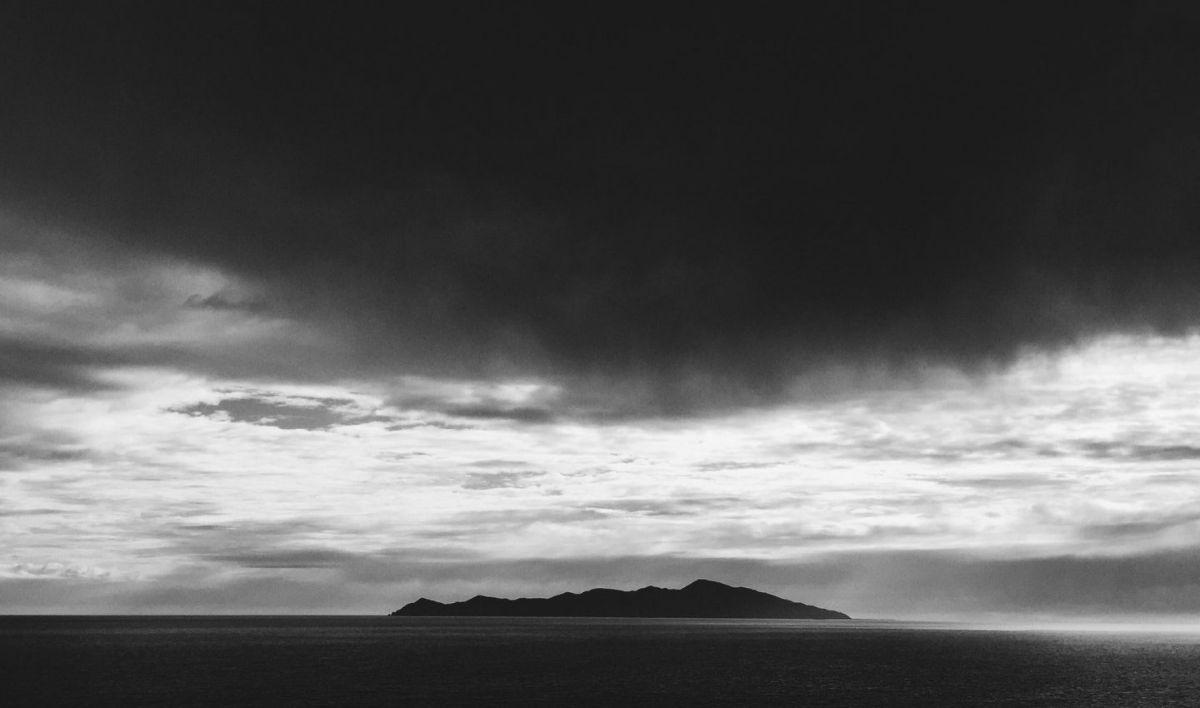
 The darkest of islands
It is an island unlike any other. It isn’t made of rock or volcanic sediment. It is an island composed of darkness.
What kind of darkness you ask? It is akin to sailing the sunny warm sea and coming upon what first appears to be an island in the distance. Drawing closer, I discover the air itself is a mass of thick black. Utter darkness.
Despite all my efforts to avoid it, the gravity of the dark thick mass pulls me in. As the front part of my vessel breaks the plane of darkness, it disappears. I enter into the black.
This is no island where wishful dreams come true. It’s a nightmare. A prison. My imagination runs wild with fears and anxieties of all that can go wrong; my regrets and depressions loom large.
I am tormented by lurking demons, monsters, and dragons that spew terror. They fill the dark air I breathe with fear about the future and frustration about the past. Both mix to make the worst of spells: hopelessness. Doing time there takes so much joy and energy out of me. When I am on the island I am less human, more animal-like. When I am in the dark, there is not much to do but sit with my racing thoughts.
It is an island I am eager to get off. Nevertheless, I am often stuck there. This is my tale of struggle with chronic fatigue and mental illness—in particular, anxiety and depression.
Darkness is my closest friend
The worst part of the dark island is how utterly alone and forgotten I feel. Why? My capacity decreases and pace slows. I can’t keep up with life. My friends are busy with their lives and have little margin to slow down and meet me where I am at.
Most don’t dare visit me when I am in the dark place. I can sense their hesitancy, their cautious approach, and their fear of relating to me in my dark unknown shadows. I get it. I have to take some of the blame. Sometimes I push them away. I don’t want anyone to see me in my darkened animal state. Darkness is my closest friend.
I also feel a social tension: social niceties dictate that people ask me how I am doing, but not everyone really wants to know. We all prefer the easy, normative answer of, “Not bad, you?” Yet, I feel that the darkness of my soul is hard to conceal. I want to be authentic, but by reading body language, I learn who to hide from and who to share with.
A few dare to enter
I am blessed to have a few patient and gracious friends that journey with me in the dark. But there are dark things in me that no human friend can face or mend. Even my most trusted friends, who offer genuine concern and prayer, aren’t able to be present with me every time I am stuck on the dark island. Don’t get me wrong, I value their presence, prayers, and concern above any other human gift. But they cannot enter into the very depths of my darkness, or constantly be with me.
Where then do I fulfill my longing for deeper spiritual connection and companionship? Shouldn’t it be God that fulfills these needs?
But if God is so caring, bold, and brave as to enter into my darkness, why don’t I often feel it? Why does he seem to leave me abandoned on the dark island so often? Can’t he, and doesn’t he want to, take me off this dark island permanently?
But the silence and darkness often seem to be the only answer.
The hopelessness of my mental illness
Day after day, I struggle on the dark island. With repeated failures to escape, disappointment sets in. I am anxious about being anxious. I am depressed about being depressed. I try to remind myself that God is powerful and good, and that he can yet help me escape the dark island. But the spiritual darkness is so thick and enduring that deep down I doubt.
At times my body is tense, pent up with frustration. I feel resentment and bitterness towards God for abandoning me. Or worse, it feels like God’s wrath and anger is heavy upon me, destroying me. I can’t feel God’s power, love, care, or presence. I despair. I can't remember what spiritual light is like.
If God doesn’t rescue me, what hope do I have? I have tried and I cannot rescue myself. My friends also can’t rescue me. Now God?
In my darkest of moments, I often prefer to die. My resolve to live in hope withers, and my faith is pale, cold, and weak.
However, after years of journeying in the dark island, I’ve noticed my heart’s cry is changing. Instead of only asking God to get me off the dark island, more and more, I am asking him to walk with me in it.
Jesus knows the darkness
Does Jesus know what it is like to live in darkness? If he does, perhaps he above anyone else can bring comfort and hope. When I meditate on what Jesus willingly went through for me, I realize how little I know of darkness in comparison.
Why did Jesus sweat drops of blood in the garden of Gethsemane? He was a man in severe physical and mental distress. He stared into the fiercest darkness and suffered from hematidrosis, a condition in which the blood vessels that feed the sweat glands rupture, causing them to discharge blood.
Why did Jesus scream in terror on the cross? He wasn’t crying out, “My hands, my feet!” His cry was of one spiritual separation, darkness, and the worst that hell could unleash. He was utterly abandoned by God. He experienced utter hopelessness.
He did everything right and everything went wrong for him.
His screaming words, “Why have you forsaken me?” reveal a soul in absolute anguish. God’s abandonment of him was real; mine is only apparent. Nevertheless, I am shocked to discover his cry is so much like mine.
Jesus, the light of the world, was plunged, willingly, into the utter darkness of hell, and not just my hell. The darkness of my island is finite and limited. He took the cosmic darkness—the cumulation of the worst nightmares and terrors ever feared or experienced in history—upon himself.
On the cross Jesus was a man disintegrating; everything about him was falling apart. It is hard enough to see even a reenactment of his body being graphically disfigured, but ultimately, it was his soul and spirit in anguish. If Jesus persevered through that magnitude of darkness to secure my salvation, it assures me that he is willing to enter my darkness now.
And not only does he walk with me in the darkness now, but I can be assured that one day he will make everything sad come untrue. Perhaps this is the saving grace of my mental illness. The struggle on the dark island makes me long for Jesus alone.
I can accept my failed hopes here because I have a future hope of a renewed, perfect body and life in the new heavens and earth, where there will be no dark island of my soul. I yearn for freedom from my darkness and fears in this life, but because Jesus walks with me now, I can endure, with patience, my times on the dark island. His hope is the quickening ray of light that promises that all good, and only good, is my ultimate destiny.
This piece was inspired by the character of Lord Rhoop in the CS Lewis book, “The Voyage of the Dawn Treader” and Tim Keller’s sermon “Heman’s Cry of Darkness” based on Psalm 88.